
Social justice discourse often relies on narratives, but these can be flawed; examining these fallacies is crucial for effective activism and policy creation.
Understanding how beliefs influence perceptions of justice, and questioning the foundations of convictions, reveals potential logical errors within popular trends.
Clarifying definitions and focusing on empirical evidence are vital steps toward rational dialogue, uncovering truths often obscured by widely held, yet unsupported, beliefs.
The Prevalence of Fallacious Reasoning in Social Justice Discourse
The tendency to prioritize narratives over factual accuracy is remarkably common within contemporary social justice discussions. Activists, driven by a desire for change, sometimes employ distorted realities to justify interventions, potentially exacerbating the very issues they aim to resolve.
This reliance on fallacious reasoning manifests in various forms, from ad hominem attacks and straw man arguments to appeals to emotion that overshadow logical analysis. The uncritical acceptance of claims, like the unsupported assertion about a young man’s pilot aspirations, demonstrates a broader pattern.
Confirmation bias further fuels this prevalence, as individuals selectively seek information confirming pre-existing beliefs while dismissing contradictory evidence, hindering objective assessment and productive dialogue.
The Importance of Fact-Checking and Empirical Evidence
Rigorous fact-checking and a commitment to empirical evidence are paramount in navigating the complexities of social justice issues. Sowell’s work underscores this necessity, advocating for a focus on demonstrable truths rather than emotionally charged narratives.
The example of the unsubstantiated claim regarding the Air Force pilot highlights the dangers of accepting assertions without verification. Inequalities exist, but attributing outcomes solely to systemic oppression, without considering individual factors or historical context, is a flawed approach.
Prioritizing data-driven analysis allows for a more nuanced understanding of societal challenges, fostering policies grounded in reality and minimizing unintended consequences. Objective assessment is crucial for genuine progress.
Common Logical Fallacies Employed
Debates frequently feature ad hominem attacks, straw man arguments, and appeals to emotion, overshadowing logical reasoning and hindering productive discourse on justice.
Ad Hominem Attacks in Social Justice Debates
Frequently, social justice discussions devolve into ad hominem attacks, dismissing arguments by attacking the character or motives of the speaker rather than addressing the substance of their claims.
Critics are often labeled with inflammatory terms – “bigot,” “racist,” or even “Nazi sympathizer” – effectively silencing dissent and avoiding genuine engagement with opposing viewpoints.
This tactic shifts focus from the merits of an argument to the perceived flaws of the individual presenting it, creating a hostile environment and impeding constructive dialogue.
Such attacks demonstrate a failure to engage with ideas on their own terms, prioritizing personal denigration over intellectual honesty and reasoned debate.
Straw Man Arguments and Misrepresentation
A common fallacy in social justice debates involves constructing a “straw man” – a distorted or exaggerated version of an opponent’s argument – and then attacking that fabricated version instead of the actual position held.
This misrepresentation simplifies complex viewpoints, making them easier to discredit, but it avoids genuine engagement with the nuances of the original argument.
By deliberately misportraying opposing ideas, proponents can create the illusion of victory while failing to address legitimate concerns or counter valid points.
Accurate representation of arguments is crucial for productive discourse; straw man tactics undermine intellectual honesty and obstruct the pursuit of truth.
Appeal to Emotion (Pathos) vs. Logical Reasoning (Logos)
Social justice discussions frequently involve strong emotional appeals (pathos), aiming to evoke empathy, outrage, or guilt. While emotions are valid, relying solely on them, without supporting evidence or logical reasoning (logos), constitutes a fallacy.
Effective arguments require a balance between emotional resonance and rational justification; Overemphasizing pathos can manipulate audiences, bypassing critical thinking and obscuring factual inaccuracies.
Logos demands evidence, data, and coherent reasoning to support claims, fostering informed understanding and constructive dialogue. A robust argument integrates both, ensuring both heart and mind are engaged.
Prioritizing logos prevents emotional manipulation and promotes a more objective assessment of social justice issues.
False Dichotomies and the “Either/Or” Fallacy
The “either/or” fallacy presents a limited number of options – typically two – as the only possibilities, when in reality, a spectrum of alternatives exists. This simplification distorts complex issues within social justice debates.
For example, framing a discussion as “you’re either with us or against us” ignores nuanced perspectives and potential middle grounds. Such binaries stifle constructive dialogue and promote polarization.
Recognizing this fallacy requires actively seeking out alternative viewpoints and challenging the assumption that only two options are viable. Complex social problems rarely have simple solutions.
Avoiding false dichotomies fosters more thoughtful analysis and encourages collaborative problem-solving.

Fallacies Related to Group Identity
Group identity often leads to generalizations and stereotypes, ignoring individual variation and perpetuating flawed assumptions about entire populations.
Essentialism denies internal diversity, while composition/division fallacies incorrectly apply group traits to individuals or vice versa.
Generalization and Stereotyping
Generalizations, while sometimes useful as starting points, become fallacious when applied rigidly to all members of a group, ignoring individual differences and complexities.
Stereotyping, a specific type of generalization, attributes fixed characteristics to individuals based solely on their group affiliation, often leading to prejudice and discrimination.
For example, assuming all members of a particular ethnic group share the same political views or intellectual capabilities is a harmful oversimplification.
Sowell highlights inherent inequalities among individuals and groups, noting variations in intelligence and historical aptitudes, like Asian representation in the NBA.
These differences don’t justify prejudice, but demonstrate the dangers of ignoring nuanced realities when discussing group dynamics and social justice.
The Fallacy of Composition and Division
The fallacy of composition assumes that what is true of the parts must also be true of the whole; conversely, the fallacy of division assumes what’s true of the whole applies to its parts.
In social justice, this manifests as believing that if some members of a group experience disadvantage, the entire group is necessarily oppressed, or vice versa.
For instance, assuming all individuals within a minority group share the same economic struggles ignores internal diversity and individual success stories.
Similarly, attributing individual achievements solely to systemic advantages overlooks personal effort and unique circumstances.
Sowell’s work emphasizes the importance of recognizing variations within groups, challenging narratives that treat them as monolithic entities.
Essentialism and the Denial of Individual Variation
Essentialism, a pervasive fallacy, posits that individuals within a group share inherent, unchanging characteristics, ignoring the vast spectrum of human diversity.
This mindset denies the significance of individual agency, effort, and unique circumstances, reducing people to mere representatives of their group identity.
Social justice narratives sometimes fall prey to essentialism by assuming shared experiences or perspectives based solely on group affiliation.
Sowell consistently critiques this tendency, highlighting the importance of acknowledging individual differences and avoiding generalizations.
Recognizing that inequalities exist among individuals, both within and across groups, is crucial for a nuanced and accurate understanding of social dynamics.

Historical and Economic Misconceptions
Distorting historical context and misinterpreting economic data are common pitfalls; accurate analysis demands nuance and a commitment to factual evidence.
Examining systemic oppression requires rigorous evidence, avoiding narratives that oversimplify complex realities and ignore crucial historical details.
Ignoring Historical Context and Nuance
A critical flaw in many social justice arguments is the tendency to present contemporary issues as isolated events, divorced from their complex historical roots. This simplification often overlooks crucial factors that shaped present-day realities, leading to inaccurate assessments of cause and effect.
Nuance is frequently sacrificed for the sake of a compelling narrative, obscuring the intricate interplay of various forces. Failing to acknowledge the specific historical context can result in misdirected efforts and ineffective solutions, as interventions are based on incomplete understandings.
Sowell emphasizes the importance of a thorough historical analysis, arguing that ignoring the past prevents us from accurately diagnosing present problems and formulating realistic strategies for improvement.
Misinterpreting Economic Data and Inequality
Social justice narratives frequently present economic inequality as solely the result of systemic oppression, often misinterpreting statistical data to support this claim. However, disparities in economic outcomes are influenced by a multitude of factors, including individual choices, skills, and varying levels of effort.
Ignoring these individual contributions and focusing exclusively on group-level disparities can lead to flawed conclusions and misguided policies. A comprehensive analysis requires acknowledging the role of personal responsibility alongside broader societal influences.
Sowell consistently highlights the dangers of selectively using economic data to reinforce pre-existing ideological biases, advocating for a more objective and nuanced understanding of economic realities.
The Narrative of Systemic Oppression – Examining the Evidence
The pervasive narrative of systemic oppression asserts that societal structures inherently disadvantage certain groups, leading to persistent inequalities. While acknowledging historical and ongoing discrimination is crucial, a critical examination of the evidence is paramount.
Sowell challenges the assumption that disparities automatically equate to oppression, arguing that differing group outcomes often stem from a complex interplay of cultural, geographic, and individual factors.
He emphasizes the importance of empirical data and rigorous analysis, questioning whether observed inequalities are genuinely attributable to systemic biases or other contributing variables. A balanced perspective requires scrutinizing the evidence, not simply accepting a predetermined narrative.
Specific Examples of Fallacies
Unverified claims, like the pilot example, demonstrate how fallacies manifest; attributing outcomes solely to discrimination, or labeling critics as bigots, are common errors.
The “Pilot” Example and Unverified Claims
Sowell utilizes Barack Obama’s memoir, Dreams From My Father, to illustrate a frequently repeated, yet empirically unsupported, claim: a young Black man abandoned his pilot aspirations believing the Air Force would deny him opportunity due to his race.
This narrative, despite its prevalence, lacks factual basis and hasn’t withstood scrutiny. It exemplifies how anecdotes, presented as evidence of systemic barriers, can be fallacious. Such stories, while emotionally resonant, shouldn’t substitute rigorous investigation and data analysis.
The danger lies in accepting unverified claims as truth, potentially shaping perceptions and policies based on inaccurate understandings of opportunity and discrimination.
Attributing Outcomes Solely to Discrimination
A common fallacy involves attributing disparities exclusively to discrimination, neglecting other contributing factors. While discrimination undeniably exists, it’s rarely the sole determinant of outcomes. Individual variations in intelligence, preparation, and choices also play significant roles.
Sowell emphasizes that inequalities exist both within and between groups, stemming from diverse origins, including prenatal care and inherent aptitudes. For instance, the underrepresentation of Asians in the NBA isn’t solely attributable to bias, but also reflects differing historical strengths and skill distributions.
Oversimplifying complex realities by solely blaming discrimination hinders effective problem-solving and obscures nuanced understanding.
Labeling Critics as Bigots or Nazis
A prevalent tactic in social justice debates is to dismiss opposing viewpoints by labeling critics as bigots, racists, or even Nazis. This ad hominem attack avoids engaging with the substance of their arguments, instead resorting to character assassination.
Such labeling shuts down constructive dialogue and creates a hostile environment, stifling intellectual exploration. It presumes malicious intent rather than considering genuine disagreements or alternative interpretations of evidence.
This approach is fallacious because it deflects from the actual issues at hand, prioritizing emotional condemnation over rational discourse and hindering any possibility of productive exchange.

The Role of Confirmation Bias
Confirmation bias drives individuals to seek information validating pre-existing beliefs, while dismissing contradictory evidence, reinforcing flawed narratives and hindering objective analysis.
Seeking Information That Confirms Existing Beliefs
Individuals often gravitate towards sources that align with their established viewpoints, a phenomenon known as confirmation bias, actively seeking data supporting their pre-conceived notions about social justice.
This selective exposure reinforces existing beliefs, creating echo chambers where dissenting opinions are minimized or disregarded, hindering a comprehensive understanding of complex issues.
Consequently, individuals may uncritically accept information confirming their biases, while simultaneously dismissing or downplaying evidence challenging their perspectives, perpetuating fallacious reasoning.
This tendency obstructs objective evaluation and fosters polarization, making constructive dialogue and the pursuit of truth increasingly difficult within social justice debates.
Dismissing Contradictory Evidence
A common manifestation of confirmation bias involves actively rejecting evidence that contradicts pre-existing beliefs regarding social justice, often labeling it as biased, flawed, or irrelevant without thorough examination.
This dismissal prevents individuals from engaging with alternative perspectives, reinforcing their initial assumptions and hindering intellectual growth, ultimately solidifying fallacious reasoning.
Such behavior can manifest as dismissing empirical data, questioning the motives of researchers, or simply ignoring information that challenges the preferred narrative, creating a distorted view of reality.
Ultimately, the refusal to consider contradictory evidence obstructs progress towards a more nuanced and accurate understanding of social justice issues, perpetuating harmful misconceptions.
Consequences of Fallacious Reasoning
Fallacious reasoning leads to harmful policies, erodes trust in civil discourse, and perpetuates injustice through misguided activism based on flawed premises and narratives.
Harmful Policies Based on False Premises
When activists distort reality with narratives justifying top-down initiatives, they frequently cause more harm than the injustices—real or perceived—they aim to correct. Policies built on unverified claims, like the example of the young man believing the Air Force wouldn’t allow Black pilots, can misdirect resources and opportunities.
Such flawed assumptions can lead to interventions that fail to address root causes, or even exacerbate existing problems. Ignoring documented facts and embracing unsubstantiated beliefs hinders effective problem-solving and obstructs genuine progress towards a more just society.
Erosion of Trust and Civil Discourse
The frequent employment of fallacious reasoning in social justice debates actively erodes trust in public discourse. Labeling critics as bigots or Nazis, for instance, shuts down meaningful conversation and fosters an environment of hostility, rather than constructive engagement.
Reliance on emotional appeals over logical reasoning further diminishes the possibility of finding common ground. When arguments are based on misrepresentation or unsubstantiated claims, it becomes increasingly difficult to have honest and productive exchanges, hindering progress towards understanding and resolution.
Perpetuation of Injustice Through Misguided Activism
When activists distort reality with narratives justifying top-down initiatives, they often exacerbate the very injustices they intend to correct. Policies based on false premises, stemming from unverified claims like the “pilot” example, can have detrimental consequences.
Attributing outcomes solely to discrimination, without considering other contributing factors, leads to misguided interventions. This approach can perpetuate cycles of disadvantage and hinder the development of effective solutions rooted in factual analysis and a nuanced understanding of complex social issues.
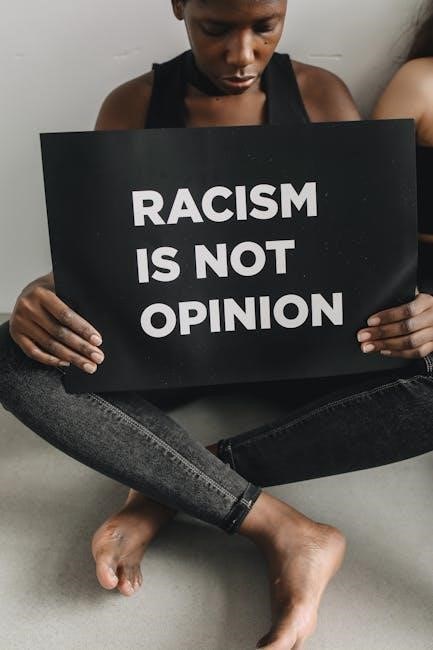
Sowell’s Critique of Social Justice Narratives
Sowell emphasizes facts and empirical data, challenging top-down initiatives, arguing that distorted narratives often cause more harm than the injustices they aim to resolve.
Focus on Facts and Empirical Data
Thomas Sowell’s core argument centers on the necessity of grounding social analysis in verifiable facts and empirical evidence, rather than relying on emotionally charged narratives or unsubstantiated claims. He advocates for a rigorous examination of data to understand inequalities, acknowledging that disparities exist both within and between groups.
Sowell points out that attributing outcomes solely to discrimination, without considering individual variations or historical context, is a fallacy. He uses the example of the aspiring pilot, highlighting how unverified assumptions can deter individuals. His approach prioritizes objective analysis, challenging the tendency to prioritize ideological agendas over demonstrable truths, ultimately seeking solutions rooted in reality.
Challenging Top-Down Initiatives
Sowell critically examines “top-down” social initiatives, arguing they often cause more harm than the injustices they intend to correct due to distorted realities and flawed premises. He suggests that activists frequently fashion narratives to justify interventions, overlooking unintended consequences and ignoring empirical evidence.
His skepticism stems from the belief that centralized planning often lacks the nuanced understanding of local conditions and individual circumstances necessary for effective solutions. Sowell champions a more decentralized approach, emphasizing the importance of allowing solutions to emerge from the ground up, guided by facts and individual agency rather than imposed ideologies.

Moving Towards a More Rational Approach
Prioritizing clarity, precise definitions, and intellectual humility fosters open dialogue and debate, crucial for dismantling fallacies and pursuing just outcomes based on facts.
Prioritizing Clarity and Precise Definitions
Ambiguity in language fuels misunderstandings and allows fallacies to flourish within social justice discussions. Defining core terms – like “oppression,” “equity,” and “justice” – with precision is the foundational step toward productive conversation.
Without shared understandings, debates devolve into talking past each other, reinforcing pre-existing biases instead of seeking common ground. Sowell’s work emphasizes the importance of operationalizing concepts, making them measurable and testable against empirical evidence.
This approach minimizes subjective interpretations and encourages a focus on demonstrable realities, ultimately leading to more effective and ethically sound solutions to societal challenges.
Embracing Intellectual Humility
Acknowledging the limits of one’s own knowledge is paramount when navigating complex social issues. Intellectual humility requires a willingness to consider alternative perspectives, even those that challenge deeply held beliefs.
Resisting the temptation to prematurely dismiss opposing viewpoints as inherently malicious or ill-informed opens the door to genuine learning and constructive dialogue. Sowell’s approach champions a fact-based assessment, prioritizing evidence over ideological commitments.
This mindset fosters a more rational and nuanced understanding of social justice concerns, reducing the prevalence of fallacious reasoning and promoting more effective solutions.
The Importance of Open Dialogue and Debate
Robust and respectful debate is essential for dismantling fallacies and arriving at more accurate understandings of social justice issues. Creating spaces for open exchange, where diverse viewpoints can be articulated and scrutinized, is crucial.
Avoiding the impulse to silence dissenting voices or label critics with pejorative terms – such as “bigot” or “Nazi sympathizer” – fosters a more productive environment. Sowell’s work underscores the value of challenging prevailing narratives with empirical evidence.
Genuine progress requires a commitment to intellectual honesty and a willingness to revise one’s beliefs in light of new information.